

By Small Ownership Landlords of Ontario (SOLO) - November 2026
Progress at the Landlord and Tenant Board — But is it enough?
The Ontario’s Landlord and Tenant Board (LTB) has reported significant progress in reducing its backlog of unresolved cases. According to the 2025–2026 Tribunals Ontario Annual Report, the number of active cases at the LTB has fallen substantially since December 2023.
This is encouraging news for landlords and tenants who depend on timely access to justice.
However, a closer examination of the figures reveals a more complicated picture. Applications continue to increase, thousands of cases remain unresolved, and important service standards are still not being met.
For Ontario’s small landlords — many of whom own only one or two rental properties — delays can have serious financial consequences.
The central question is no longer simply whether the LTB is reducing its backlog, but whether small landlords can obtain timely and effective resolutions when disputes arise.
1. What the numbers tell us
The latest annual report provides several important indicators of the LTB’s performance during the fiscal year ending March 31, 2026.
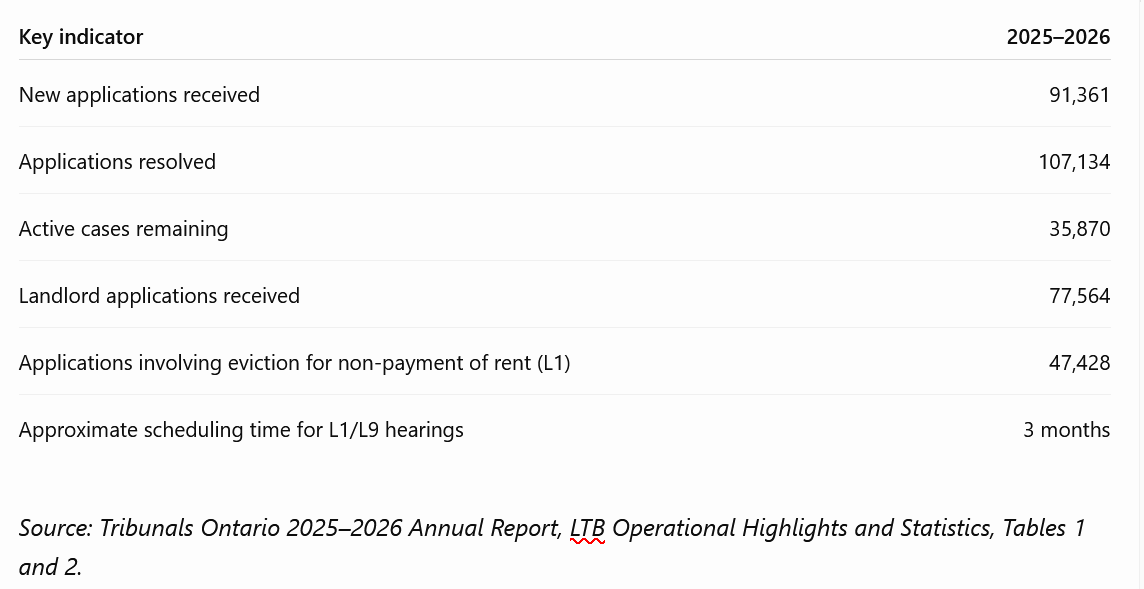
The LTB reduced its active caseload from 41,465 in March 2025 to 35,870 in March 2026 — a reduction of approximately 13.5%. However, the Board also received 91,361 new applications, an increase of 3.8% over the previous year.
While more cases were resolved than received, the volume of new applications demonstrates the continuing pressure on Ontario’s rental dispute resolution system.
For small landlords, these figures represent more than administrative statistics. Behind each application may be a property owner trying to recover unpaid rent, resolve a tenancy dispute or meet financial obligations.
2. Non-payment of rent remains a major concern
One of the most revealing findings is the number of applications involving non-payment of rent.
During 2025–2026, the LTB received 47,428 L1 applications, compared with 45,435 the previous year. That represents an increase of approximately 4.4%. L1 applications accounted for more than 61% of all landlord applications received during the reporting period.
For a small landlord, unpaid rent can quickly become a financial emergency. Mortgage payments, municipal property taxes, insurance, maintenance and utility bills do not stop when rental payments are missed.
Consider a landlord renting a single unit for $2,200 per month. If rent remains unpaid for three months, the landlord faces $6,600 in lost rental income — before accounting for legal expenses, financing costs or other property-related obligations.
This is an illustrative example, not an average loss reported by Tribunals Ontario.
Unlike large property management companies, small landlords may have limited reserves or other rental income to absorb prolonged financial losses.
A delay that appears manageable in an administrative report can be financially devastating for an individual housing provider.
3. Hearing delays: The difference between scheduling and justice
The LTB has reported improvements in scheduling hearings and issuing decisions. Nevertheless, its own performance indicators show that important targets remain unmet.
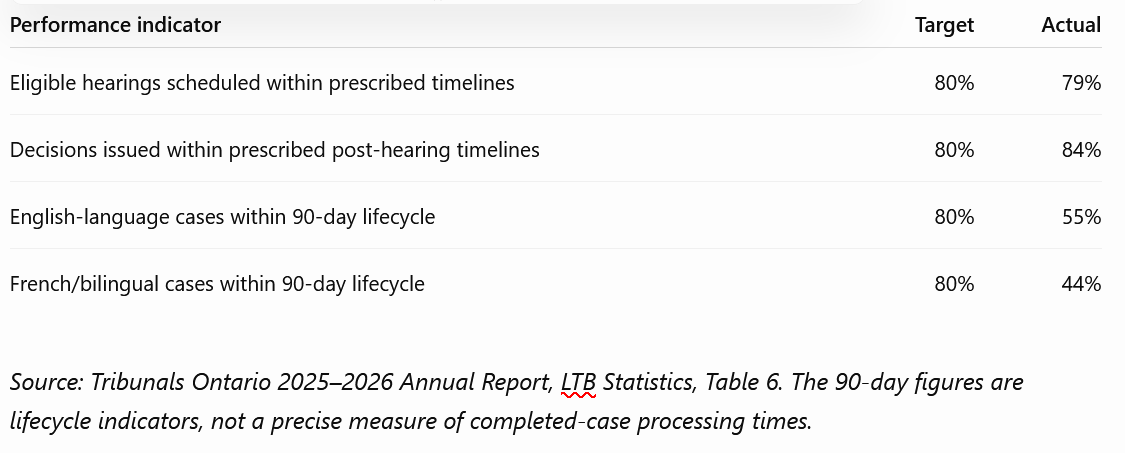
Although the Board met its decision-issuance target, it fell considerably short of its 90-day lifecycle objectives. More importantly, scheduling a hearing is not the same as resolving a dispute. A landlord may still face additional waiting periods involving hearings, adjournments, decisions and enforcement. Even after obtaining an order, recovering outstanding rent or regaining possession of a property may require further steps.
For small landlords, the true measure of an effective system should be the time required to reach an enforceable resolution — not simply the number of hearings scheduled.
4. Why delays matter beyond individual landlords
The consequences of LTB delays can extend beyond the immediate landlord-tenant relationship.
Small landlords contribute to Ontario’s rental housing supply through basement apartments, secondary suites, condominiums, duplexes and other residential properties.
When operating a rental property becomes financially unpredictable, some owners may reconsider purchasing, maintaining or continuing to offer rental accommodation.
Prolonged disputes can also create uncertainty for tenants and complicate efforts to maintain properties and resolve disagreements constructively.
These are potential consequences, not outcomes quantified in the annual report.
A fair and efficient dispute resolution system benefits both landlords and tenants. It provides clarity, encourages compliance with the law and helps maintain confidence in Ontario’s rental housing sector.
5. Recognizing improvements while calling for greater accountability
SOLO recognizes the progress reported by Tribunals Ontario. The LTB has increased adjudicative capacity, expanded alternative dispute resolution services and introduced administrative improvements intended to make the system more accessible.
As of March 31, 2026, the LTB reported 132 adjudicators, including 78 full-time and 54 part-time members. The report also indicates that 16% of cases were resolved in whole or in part through alternative dispute resolution.
These developments are welcome.
However, improvements in overall caseload management must translate into measurable improvements for the people who use the system.
The annual report does not identify how many applications involve small landlords, how much unpaid rent is outstanding, or how long it takes to achieve final enforcement.
Without this information, it remains difficult to assess whether smaller housing providers are benefiting proportionately from the reforms.
6. What SOLO believes the Ontario government should address
The findings provide an opportunity for constructive dialogue with the Ontario government about improving the LTB.
SOLO believes that the following priorities deserve consideration:
Faster resolution of non-payment cases: Establish and monitor realistic end-to-end processing standards, particularly for applications involving substantial rental arrears.
Greater transparency: Publish regular statistics showing actual processing times from application filing through final orders, including delays caused by adjournments.
Recognition of small landlords: Collect information that distinguishes the experiences of small housing providers from those of large property management companies.
Sustainable administrative capacity: Ensure that staffing, adjudication resources, mediation and technology improvements keep pace with application volumes.
Fair and accessible dispute resolution: Maintain due process and protections for both landlords and tenants while reducing unnecessary delays and administrative barriers.
These priorities are proposals for consideration, not recommendations made by Tribunals Ontario in its annual report.
7. Small landlords need a stronger voice at Queen’s Park
Ontario’s small landlords are an important part of the province’s rental housing landscape. Yet their experiences and financial realities are not separately identified in the LTB performance figures.
A landlord operating one or two rental units may face very different financial pressures from a corporation managing hundreds of properties. Public policy should recognize these differences.
This is why collective representation matters.
The Small Ownership Landlords of Ontario (SOLO) advocates for the interests of small housing providers and seeks constructive engagement with the Government of Ontario on issues affecting the rental housing sector.
By working together, small landlords can help bring attention to the practical consequences of LTB delays and contribute to discussions about fair, effective and sustainable rental housing policies.
8. Join SOLO — Your voice matters
Are you a small landlord in Ontario? Have you experienced delays at the Landlord and Tenant Board, unpaid rent or difficulties resolving a tenancy dispute?
Your experience matters.
SOLO invites Ontario’s small landlords to become members and help strengthen our collective voice.
Together, we can advocate for:
A more efficient and accountable Landlord and Tenant Board.
Fair treatment of small housing providers.
Greater transparency in rental housing policy.
Practical reforms that recognize the financial realities of small landlords.
Constructive dialogue with the Ontario government.
The challenges facing Ontario’s small landlords cannot always be addressed individually. Through organized representation, members can participate in a stronger, more informed discussion with provincial decision-makers.
Join SOLO today and help advocate for a fairer, more efficient rental housing system in Ontario.
Visit www.solo.ca to learn more about SOLO and membership opportunities.
Sources and Editorial Note
Primary source: Tribunals Ontario 2025–2026 Annual Report — Landlord and Tenant Board
Reporting period: April 1, 2025 – March 31, 2026.
References: LTB Operational Highlights; LTB Statistics, Tables 1, 2 and 6.
This article is based on an analysis of the published annual report. The statistics represent overall LTB activity and do not separately identify small landlords. Financial examples are illustrative. Policy proposals and advocacy positions expressed in this article are those proposed for SOLO, not findings or recommendations of Tribunals Ontario.
This article is provided for general information and public policy discussion. It does not constitute legal or professional advice.