

For Ontario’s small residential landlords, including members of Small Ownership Landlords of Ontario (SOLO), the key question is whether the new federal budget provides meaningful financial relief, encourages investment in rental housing, and helps small property owners remain in the rental market.
It is important to distinguish between direct benefits to existing small landlords and federal housing initiatives primarily designed to encourage new construction. It is also important to know that landlords and tenant disputes are exclusive provincial jurisdiction through the Landlord and Tenant Board in Ontario.
What the federal November 5, 2026 budget offers
The federal government released Budget 2026: “Masters of our destiny today.” Its headline priorities include housing construction, investment incentives, affordability measures, and energy-efficient home retrofits.
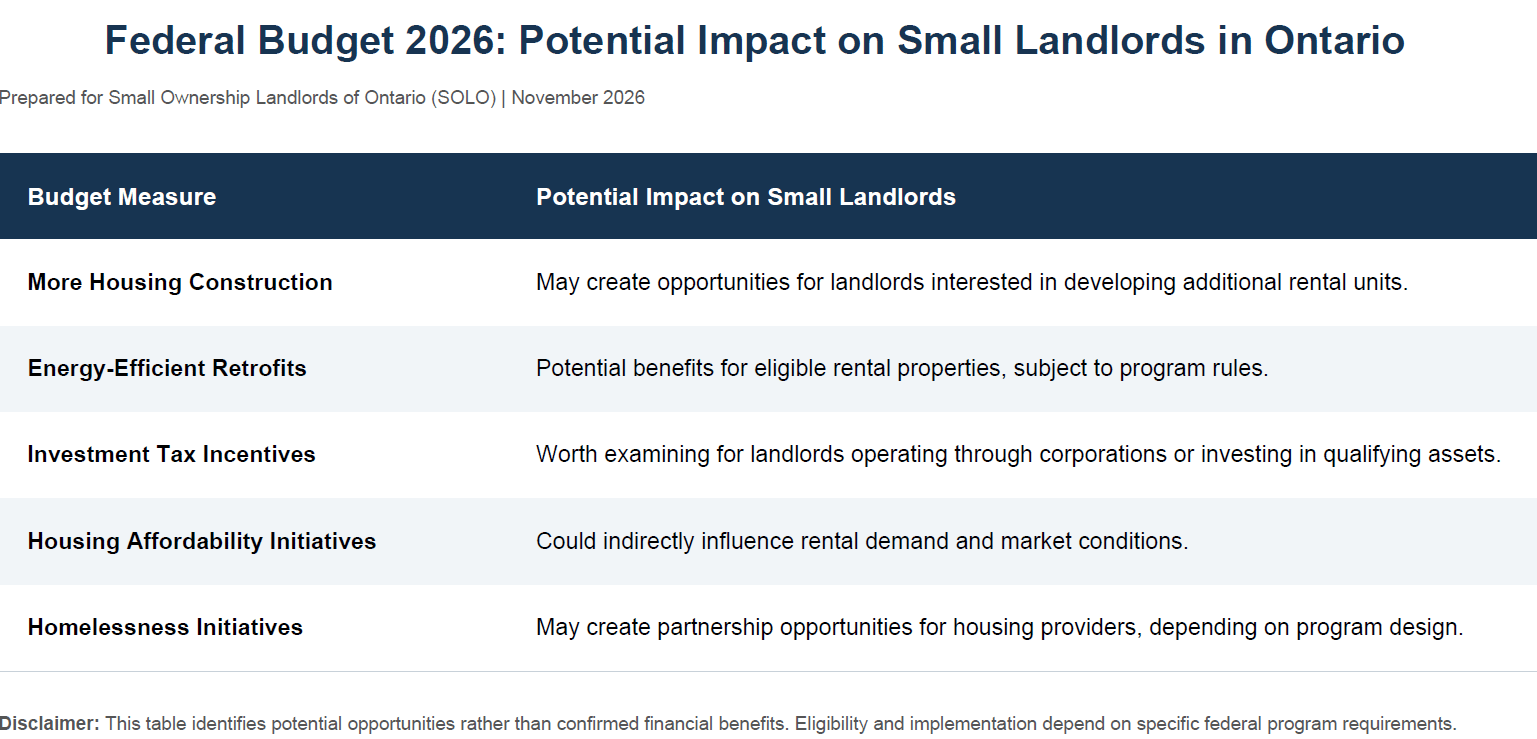
This budget appears more focused on expanding housing supply than providing direct financial relief to owners of existing small rental properties. The announcement alone does not establish eligibility for individual landlords.
Three opportunities worth examining for SOLO members
1. Financing for small multi-unit properties
The federal government’s Spring 2026 update proposed greater mortgage-insurance flexibility for three- and four-unit developments and five- to eight-unit residential properties. This could be particularly useful to smaller investors, although these proposals predate today’s budget and their implementation status needs verification.
2. Tax advantages for new rental construction
Existing federal measures include a 100% GST rental rebate for qualifying new purpose-built rental housing and accelerated depreciation for eligible projects. However, the GST rebate generally requires at least four residential units or ten private rooms, so many small landlords with one or two rental units will not qualify.
3. Energy-efficiency programs
Budget 2026 proposes $2 billion toward retrofitting one million homes, including heat-pump support and programs for larger buildings. SOLO should seek clarification about whether owners of small rental properties can participate.
Small housing providers may wish to consult SOLO-recommended professionals to weigh their options before making any investment decisions.
What appears to be missing for small landlords?
From this initial review, we have not identified a new, specific federal measure addressing:
Tax relief for individual owners of existing rental properties.
Financial assistance for unpaid rent or damage caused by tenants.
Relief from increasing insurance, maintenance, and financing costs.
Dedicated support for landlords operating one to four rental units.
These are preliminary findings. Dedicated experts may wish to review the entire budget before confirming that it contains no relevant provisions.
Our recommendation for SOLO housing providers
SOLO could use Budget 2026 to advocate for a Small Rental Housing Providers Support Program at the provincial level, emphasizing that maintaining existing rental housing - through streamline support for non rent payment - is just as important as constructing new units.
A practical advocacy agenda would include targeted renovation incentives, improved financing access for small rental properties, and recognition of the financial risks borne by small housing providers.
Official sources: Federal Budget 2026 – Economic and Fiscal Overview and Budget 2026 – Fiscal Measures.